
I remember the exact moment it happened. I was sitting at my kitchen table, minding my own business with a slice of sourdough toast, when I heard a sickening, crystalline crunch. It wasn’t the crust. My heart sank as I felt a jagged edge with my tongue where my smooth front tooth used to be. My expensive porcelain veneer, the one I had saved up for months to get, had finally met its match against a piece of bread. In that moment, I was convinced I was out another few thousand dollars and weeks of dental appointments. But here is the good news: I was wrong. You don’t always have to toss the whole thing out.
Don’t Panic When You Feel That Sharp Edge
My first instinct was a total disaster. I actually thought about using a nail file to smooth it out myself just to stop the scraping on my lip. Please, whatever you do, do not follow in my early, panicked footsteps. I quickly learned that how to stop a small chip in your tooth from getting bigger starts with keeping your hands (and files) away from it until you talk to a pro. We are living in a golden age of dental materials. Today, we can often use composite bonding—the same stuff used for fillings—to patch that porcelain seamlessly. It is about saving your investment rather than replacing it. This matters because a full replacement is invasive and pricey, while a repair is often done in thirty minutes. Have you ever had that heart-stopping moment where you realized your smile wasn’t quite ‘whole’ anymore?
Will a patched veneer actually look like the real thing?
This is where most people get skeptical, and I was right there with them. I worried my tooth would look like a patchwork quilt of different whites. However, modern resin kits allow dentists to layer colors to mimic the natural translucency of porcelain. In fact, professional techniques for how we match the exact texture of your teeth are so advanced now that even under bright bathroom lights, the seam is invisible. There are plenty of cosmetic dentistry myths suggesting porcelain cannot be bonded to, but according to the American Academy of Cosmetic Dentistry, specialized silane coupling agents create a chemical bond between the old porcelain and the new resin that is remarkably sturdy. It won’t last forever—maybe three to five years—but it buys you a lot of time and saves your wallet today. [image placeholder]
How Your Dentist Patches the Porcelain Without a Total Redo
Think of a veneer repair like high-stakes auto-body work for your face. When I finally dragged my sorry, chipped tooth into the clinic, I expected a jackhammer. Instead, the process was remarkably quiet and precise. The core technique involves creating a mechanical and chemical bridge between the old ceramic and a new composite resin. It is not as simple as dabbing on some glue; it requires a sterile, bone-dry environment to ensure the patch doesn’t pop off the next time you encounter a crusty baguette. Much like how we reshape jagged teeth without using any anesthesia, the repair of a veneer is usually a ‘needle-free’ zone because the work is happening on the surface of the porcelain, far away from your sensitive nerves.
The Surface Prep That Makes Resin Stick
The first thing my dentist did was ‘scuff’ the porcelain. This sounds terrifying—intentionally scratching an expensive veneer—but it is the most critical step. Porcelain is naturally glass-smooth, which is terrible for sticking things to. By using a tiny, high-pressure sandblaster or a specialized acid etch, the dentist creates a microscopic mountain range on the tooth surface. Once the surface is porous, they apply a ‘silane’ coupling agent. This chemical acts like double-sided tape, where one side grabs the porcelain and the other grabs the plastic resin. If your dentist skips this, the repair will fail within a week. I remember a friend who tried a DIY kit from a drugstore; because she couldn’t achieve this chemical bond, her ‘patch’ fell into her soup during a first date. Don’t be that person. 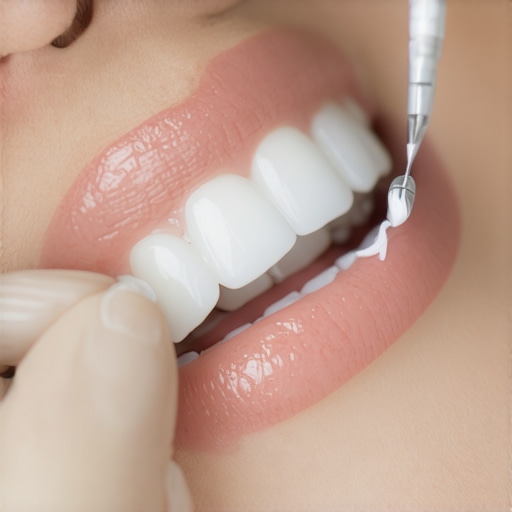
Matching the Shine So It Doesn’t Look Fake
The real artistry happens during the layering. Your natural teeth aren’t just one solid block of white. If you look closely, you might see the reason your front teeth look transparent at the very bottom is due to the way light passes through the enamel. To mimic this, the dentist uses different ‘opacities’ of composite. They might put a dense, milky white at the core and a translucent, glass-like layer on the very edge. When I had mine done, I was obsessed with the mirror. I kept checking for a line where the old tooth ended and the new one began. The secret is the final polish. They use progressively finer diamond-impregnated discs to buff the resin until its ‘luster’—the way it reflects the overhead lights—matches the surrounding porcelain exactly. This level of detail is a hallmark of the secret to a Hollywood smile where repairs remain invisible even to the sharpest eye.
The Clink Test for Durability
Once the blue curing light has hardened the resin, it’s time for the moment of truth. My dentist had me perform what I call the ‘clink test.’ I tapped my teeth together gently and then used a fingernail to flick the edge of the repair. If it sounds ‘hollow,’ the bond is weak. If it sounds like a solid piece of stone, you’re in business. You can even use the clink test to tell if your porcelain veneer is actually loose or if it’s just the new patch settling in. I spent the first forty-eight hours after my repair eating nothing but yogurt, terrified of the ‘crunch’ returning. But by day three, I realized the bond was incredibly resilient. This isn’t a permanent fix—it’s more of a very high-quality band-aid that buys you several years of life—but when done correctly, it restores your confidence instantly without the trauma of a full replacement.However, the mistake most people make is assuming that a repair is a sign of a failed procedure. In reality, it’s often a sign that your mouth is a living, changing environment. We often hear that porcelain is the gold standard because it never stains, but according to a study published in the Journal of Adhesive Dentistry, the interface between the porcelain and the repair resin is where the real battle for longevity is won or lost. If your dentist doesn’t account for the subtle flex of your natural tooth under pressure, even the strongest bond will eventually shear off. This is a common pitfall in cosmetic dentistry myths—the idea that the material is the only thing that matters, when in fact, your individual bite alignment is the true hero of a lasting fix.
The hidden reason your repair might fail next week
Most patients don’t realize that the biggest trap isn’t the dentist’s technique; it’s the underlying habits that caused the chip in the first place. If you are a chronic night-grinder, that new resin patch is basically a target. It is vital to prioritize maintaining your teeth cleaning routine while potentially adding a night guard to protect your investment. I once ignored my dentist’s advice about a guard, thinking my new smile was cured. Three weeks later, I was back in the chair with the same jagged edge. Have you ever fallen into this trap of thinking a dental fix was indestructible? Let me know in the comments.
Does the age of your original porcelain change how well a patch sticks?
Surprisingly, yes. Research into dental surface chemistry shows that older porcelain, which has been exposed to years of saliva and temperature changes, can develop a leached surface layer that resists standard bonding. An expert dentist knows that older veneers require a more aggressive, controlled acid etch than a brand-new one to create a fresh surface. If you skip this critical preparation phase, you’re just stacking cards in a windstorm. This level of nuance is why teeth cleaning secrets aren’t just about removing plaque; they’re about maintaining a pristine environment for long-term dental adhesion. I’ve seen patients demand a whole new veneer because they didn’t trust a patch, not realizing that every time you replace a veneer, you have to remove a tiny bit more of your natural enamel. Over time, this cumulative loss is why your teeth look shorter than they did ten years ago—it’s often a result of repeated over-treatment rather than simple wear. #IMAGE_PLACE_HOLDER_C#
Stop treating your cosmetic work like it is bulletproof
Another hidden nuance involves the metamerism of dental materials. This is a fancy way of saying that the color of your repair might look perfect in the dental office but completely different under the sun or at a restaurant. This happens because composite resin reflects light at different wavelengths than porcelain. To avoid an obvious patch, top-tier cosmetic pros will check the shade under multiple light sources. If your dentist only uses the bright overhead LED, you might find the real reason your teeth look yellow in bathroom lighting is actually a mismatch in the repair material’s base tone. Knowing these small details is the secret to a Hollywood smile that remains invisible regardless of the environment. By focusing on these high-level nuances, you move beyond simple repair and into a philosophy of long-term tooth preservation.The real secret to making these repairs stick isn’t just what the dentist does; it’s the gear you have in your bathroom cabinet. I used to think a standard toothbrush was enough, but after my first chip, I realized that Invisalign maintenance expert tips apply to almost all cosmetic work. The tool that changed the game for me was a dedicated ultrasonic cleaner. I’m not talking about a jewelry cleaner from a big-box store, but a high-frequency dental-grade unit. According to Dr. Gordon Christensen of Clinical Research Associates, high-frequency ultrasonic vibrations are significantly more effective at removing stubborn biofilm on dental appliances than manual scrubbing, which can actually create microscopic scratches. These scratches are where stains live. If you are struggling with how to clean the stubborn cloudiness off your night guard, this is the only way to do it without ruining the finish. 
How do I make this repair last for the long haul?
Longevity is a team sport between you and your hygienist. When you go in for your six-month visit, you need to tell them exactly where the repair is. Standard gritty prophy paste can dull the shine of a composite patch in seconds. I always ask for a ‘fine’ grit or a specialized polishing paste designed for aesthetic restorations. This is part of those teeth cleaning secrets that pros use to keep their own work looking fresh. Beyond the chair, I’ve started using a water flosser on the lowest setting around my veneers. It’s far more gentle than traditional floss which, if snapped too hard, can actually catch on the margin of a repair and lift it. We are seeing a massive shift in cosmetic dentistry trends toward ‘preventative maintenance’ rather than ’emergency fixes.’ I predict that by 2030, we will all have AI-powered cameras in our toothbrushes that alert our dentists the second a bond shows signs of fatigue. For now, your best bet is staying proactive. My challenge to you is to stop scrubbing your dental appliances today and switch to an ultrasonic bath—it is the single best investment you will make for your smile.
The hardest lesson I learned about keeping my smile intact
The biggest shift for me was realizing that cosmetic work isn’t a “set it and forget it” situation. I used to think of my porcelain like a diamond—indestructible. But it’s more like a luxury car; it needs high-end maintenance. Here are the lightbulb moments that saved me: First, cosmetic dentistry myths often lead us to believe repairs are impossible, but the science of bonding is incredible when you trust the process. Second, a chip isn’t a catastrophe, it’s a maintenance check. Third, the texture of your tooth matters as much as the color, and your dentist’s ability to layer resin is what truly brings back the secret to a Hollywood smile.
[image placeholder]
The toolkit that keeps my repair invisible
To keep that patch looking fresh for years, you need the right gear in your corner. I swear by my dental-grade ultrasonic cleaner for my night guard. It prevents that cloudy buildup that can harbor bacteria. I also suggest switching to a water flosser, as it’s much gentler on the margins of a repair than traditional string. When you go for your checkup, always remind your hygienist about the repair so they can use a specialized polishing paste. Following these Invisalign maintenance expert tips even for veneers will extend the life of your bond significantly.
How to stop worrying and love your smile again
At the end of the day, your smile is there to help you live your life—to laugh, to eat sourdough (carefully!), and to connect with others. Don’t let a small chip steal your confidence. Modern cosmetic dentistry is about flexibility and preservation, not just perfection. By maintaining your teeth cleaning routine and being proactive about small fixes, you keep your investment safe without the stress of constant redo’s. You deserve a smile that makes you feel whole, even if it has a tiny, invisible patch or two. Have you ever had a dental repair that lasted much longer than you expected? Let me know below.