
I remember standing in my bathroom, staring at my reflection under the harsh LED vanity lights, and feeling a pit in my stomach. I’d just spent a significant amount of money on what I thought was the perfect smile, but something was… off. My new front tooth was the right color. It was the right shape. But it looked like a piece of polished plastic stuck in the middle of a row of real teeth. It didn’t have the tiny ‘valleys’ and ‘ridges’ that my other teeth had. It was too smooth, too perfect, and frankly, it screamed ‘fake’ every time the light hit it. This was the moment I realized that color is only half the battle in achieving a Hollywood smile; the real secret lies in the microscopic texture that mimics mother nature.
That Moment I Realized My New Tooth Looked Way Too Perfect
When I first started looking into cosmetic dentistry for discolored teeth, I made a classic rookie mistake: I thought ‘smooth’ meant ‘high-quality.’ I actually argued with my lab technician because I wanted my veneers to feel like glass. I didn’t realize that natural tooth enamel is actually quite complex. It has tiny horizontal ridges called perikymata and subtle vertical grooves that break up light. When a veneer is perfectly flat, it reflects light in a single, harsh beam—a dead giveaway that you’ve had work done. Today, I’m going to show you exactly how we avoid that ‘chicklet’ look by mapping the unique ‘topography’ of your mouth. We are going to dive into the artisan techniques used to ensure your new smile doesn’t just match the shade of your neighboring teeth, but also their personality. If you have ever worried about why your porcelain veneers feel bulky or unnatural, the answer is almost always a lack of proper surface characterization.
Is This Level of Detail Really Worth the Extra Effort?
You might be thinking, ‘It’s just a tooth, who is going to look that closely?’ But the human eye is incredibly good at spotting anomalies in a smile. In fact, a study published by the Journal of Prosthetic Dentistry highlights that surface roughness and gloss are critical factors in how the brain perceives the ‘vitality’ of a dental restoration. Without those tiny imperfections, the tooth looks ‘dead.’ This is why we spent so much time on matching the texture of a crown or veneer to its neighbors. We use digital impressions and hand-finishing to recreate the way your specific enamel scatters light. Whether you are currently choosing the right dentist for a full makeover or just a single tooth fix, you need to know about these textures. Have you ever looked at a dental fix in the mirror and felt like it stood out, even if the color was a perfect match? I’d love to hear your story in the comments. We’re about to break down the three-step process of surface mapping that changes everything.
The Blueprint for a Smile That Passes the Mirror Test
To avoid the ‘plastic’ look, we have to move beyond just choosing a shade from a cardboard tab. True realism comes from the way light interacts with the surface of the tooth. When I was first learning about surface characterization, I had a patient who wanted a single front crown. We matched the color perfectly, but it stood out like a sore thumb because it was too smooth. I had to take that crown back to the lab bench and manually create micro-grooves to mimic his natural anatomy. This taught me that matching the texture of a crown is the difference between a ‘procedure’ and ‘art.’ We now use a three-step surface mapping protocol that ensures your new teeth blend seamlessly into your mouth.
Why We Take a High-Def Map of Your Enamel Valleys
Everything starts with a digital topography. Just like a map shows mountains and canyons, your natural teeth have a landscape. We use high-resolution digital scans to identify your specific ‘perikymata’—those tiny horizontal growth lines that develop as your teeth form. If your dentist ignores these, the light will reflect off the tooth in a flat, unnatural sheet. This is one of the many cosmetic dentistry trends that transform smiles today, moving away from the ‘Hollywood White’ of the early 2000s toward ‘Biomimetic Realism.’ We look for the ‘incisal halo’ and the subtle translucency at the edges, ensuring that the new tooth doesn’t look like it belongs in someone else’s mouth.
Ditch the Flat Finish for Hand-Sculpted Ridges
Once we have the map, the fabrication process begins. We use a technique called ‘cut-back and layering.’ Instead of using a single block of porcelain, we build the tooth in layers of varying translucency. This mimics the natural structure where the dentin is opaque and the enamel is clear. I remember a specific case where a patient was worried because their new teeth looked jagged on the bottom edge during the wax-up phase. I had to explain that those ‘mamelons’ are what give young teeth their vitality. If we make them perfectly flat, they look like dentures. We hand-grind the surface with diamond burs to create a ‘satin’ finish rather than a ‘high-gloss’ finish.
Control the Way Your Smile Catches the Light
The final step is the luster control. Natural teeth aren’t uniformly shiny; they have areas of high polish and areas of matte texture. During your final fitting, we check how the tooth looks under different lighting conditions. You might notice your teeth feel sharp after a professional cleaning because the surface texture is being revealed; we want that same crispness in your veneers. If the surface is too smooth, it looks like a chiclet. If it is too rough, your dental implant crown feels gritty against your tongue. We balance this by using polishing pastes of different grits to achieve a multi-dimensional shine. This level of detail is also why how we match porcelain veneers to your specific complexion involves more than just color—it involves the ‘glow’ of the material itself. We also check the bite carefully, because the reason your crown feels tall is often due to the micro-geometry of the chewing surface, which must be calibrated alongside the visual texture. This is the new standard in modern teeth cleaning and cosmetic innovations that prioritize both health and aesthetics.People often assume that cosmetic dentistry is a one-and-done aesthetic fix, but I have seen so many patients focus solely on the ‘Hollywood White’ without considering how their teeth actually function. Everyone says a straight smile is purely about confidence, but in my experience, alignment is actually the ultimate preventive health tool. If your bite isn’t calibrated, those beautiful veneers are going to chip or pop off because of the physics of your jaw. One of the biggest traps is thinking that clear aligners are just for fixing the front teeth. I have had many people ask me about choosing the best invisalign options for your lifestyle only to realize later that the most important part isn’t the look—it is the ‘occlusion’ or how the teeth meet. If you ignore the back molars, you are setting yourself up for TMJ issues later.
Why Does My Bite Feel Off Even When the Scans Say It is Perfect?
This is a sophisticated question that gets to the heart of clinical expertise. Digital scans are amazing, but they cannot always account for the ‘proprioception’ of your ligaments. A study in the International Journal of Dentistry notes that even a 20-micron discrepancy in a restoration can be detected by the human mouth as a ‘foreign object’ sensation. This is why the reason your crown feels tall when you first bite down isn’t just in your head; it is a biological mismatch that needs manual adjustment. We use these insights to refine the final fit, ensuring the material doesn’t just look natural but feels like part of your anatomy.
Don’t Let Your New Smile Become a High-Maintenance Nightmare
The ‘Oops’ factor I see most often is the assumption that ‘clear’ means ‘clean.’ I see so many patients ruin their progress because they don’t know how to stop invisalign trays from making you talk with a lisp or, more importantly, they neglect invisalign maintenance expert tips for clear confident smiles. If you aren’t cleaning the attachments properly, you can actually develop ‘white spot lesions’ under the plastic. It is a common myth that you can just ‘rinse and go.’ Have you ever fallen into this trap where you prioritized the look over the daily care routine? Let me know in the comments. We need to stop viewing cosmetic dentistry trends that transform smiles beyond expectations as just vanity—it is about the intersection of art and engineering. If your dentist isn’t talking about your ‘bite path,’ you might be choosing the right dentist for the wrong reasons. True expertise means looking at how your smile will perform five years from now, not just how it looks in a selfie today.If there is one thing I have learned after years of fine-tuning my dental health, it is that the dentist builds the house, but you are the one who has to maintain the foundation. It is not just about brushing anymore; it is about the precision tools you use to fight biofilm in those microscopic gaps. For my Invisalign users, I swear by the iSonic F3900 Ultrasonic Cleaner. I do not just rinse my trays; I let high-frequency sound waves vibrate the microscopic bacteria off the plastic. This is the only way to ensure your invisalign maintenance expert tips for clear confident smiles actually work over the full two-week tray cycle. If you skip this, the trays get cloudy, and they start to trap acids against your enamel. I also tell everyone to upgrade to a brush with a pressure sensor, like the Oral-B iO series. How regular teeth cleaning can prevent major dental issues starts with what you do at 7 AM in your own bathroom, and preventing ‘scrubbing’ damage to your veneers is priority number one.
The Tools That Actually Save Your Smile After the Doctor Finishes
Beyond the basics, I recommend a specialized kit for anyone who has invested in porcelain. According to a study published in the International Journal of Oral Science, the mechanical removal of biofilm using oscillating-rotating technology is significantly more effective at preserving the integrity of the ‘restoration margin’ than manual brushing. This margin—the tiny line where your veneer or crown meets your natural tooth—is the most vulnerable spot for decay. I personally use a Waterpik Aquarius on a medium setting to flush out these areas. It is much more effective than traditional floss if you are worried about the hidden reason your floss keeps shredding. 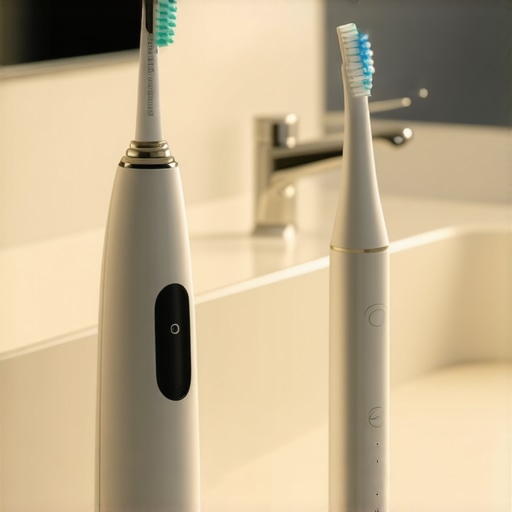
How do I maintain these results over the next decade?
It comes down to a strategy I call ‘The Trifecta’: professional irrigation, occlusal guards, and chemical balance. Even if you have the best invisalign options for your lifestyle, you absolutely need a custom night guard. Porcelain is incredibly strong, but the human jaw can exert over 200 pounds of pressure during sleep. Without a guard, you are essentially asking your expensive new teeth to survive a nightly car crash. Maintaining your teeth cleaning routine for long-term health also means being mindful of your mouth’s pH. I use a pH-neutralizing mouthwash after drinking coffee to ensure I am not softening my enamel before I brush.
A Glimpse into the Future of Your Morning Routine
Looking forward, I predict we are moving toward real-time bio-feedback in our dental care. We are already seeing invisalign innovations that include remote monitoring through your smartphone, but soon, we will have ‘smart’ retainers that alert you if your saliva chemistry indicates a coming cavity. This is part of the broader cosmetic dentistry trends that transform smiles beyond expectations, moving away from reactive fixes toward proactive bio-hacking. For now, my most advanced tip for you is this: invest in a high-quality tongue scraper. It reduces the sulfur-producing bacteria that can degrade the luster of your dental work over time. Give it a try for one week—your breath and your veneers will thank you.
The Unfiltered Truth About Life After the Dental Chair
Reflecting on my own journey, I realized that the most expensive smile is the one you have to pay for twice. If I could go back, I would tell myself that perfection is actually the enemy of realism. I spent weeks worrying about the shade, but I should have been asking about the surface anatomy. Many cosmetic dentistry myths debunked today suggest that once the porcelain is on, you are done. In reality, that is just the starting line. I also learned that teeth cleaning myths debunked by top dentists often hide the fact that aggressive brushing can actually dull your investment over time. It is a delicate dance between cleanliness and preservation. You have to treat your new smile like a fine piece of art, not a set of utility tools.
My Daily Toolkit for a Flawless Finish
To keep things looking and feeling great, I do not rely on luck. I use an ultrasonic cleaner for my retainers every single morning without exception. If you are following the ultimate guide to invisalign for adults in 2025, you know that keeping those trays clear is vital for your confidence. #IMAGE_PLACEHOLDER_E# I also suggest keeping a small ‘smile kit’ in your car: a travel brush, a pH-balancing rinse, and a high-quality tongue scraper. These are not just accessories; they are the insurance policy for your dental work. When you combine these tools with invisalign maintenance expert tips for clear confident smiles, you ensure your treatment stays on track and remains virtually invisible.
Your Journey to a More Confident You Starts Now
The technology available today is truly mind-blowing, but it still requires a human touch and your personal commitment. Do not be afraid to ask the hard questions when how to choose a dentist for your invisalign transformation becomes your top priority. You deserve a smile that makes you want to laugh louder and speak more clearly. Your oral health is an investment in your overall well-being, and every small step you take today—from better cleaning habits to choosing the right professional—pays dividends for a lifetime. What is the one thing that has been holding you back from starting your own smile transformation? Drop your questions below and let’s talk about it!